NATIONAL DAY ON WRITING: October 20, 2009
“Celebrate Charleston through Writing”
Proposal
We're proposing that the LWP host events to celebrate the National Day on Writing. Let us know if you want to get involved!
IN THE SCHOOLS
Students will enter a writing contest "Celebrate Charleston through Writing" in which students will write about Charleston, teachers will choose the best ones to nominate, and then the winners will read at a special event on October 20th, the National Day on Writing.
“Celebrate Charleston through Writing” allows teachers to create assignments that will elicit a wide variety of research and writing skills. Students might engage in traditional, library-based research using primary or secondary sources, they might conduct interviews with friends or relatives, or they might conduct first-person research by visiting a location or participating in an activity. They could use this information in a variety of documents; for example, Standards E4-5.2, E4-5.3, and E4-5.4 list the following genres as samples: personal essay, memoir, narrative poem, personal essay, travel writing, restaurant review, editorial, essay, speech, and report.
A single activity could, of course, lead to a variety of kinds of writing. For example, a student might attend a Battery, Riverdogs, or Stingrays game, then write a narrative (of the experience), a description (of the game, the venue, the team, or the crowd), a persuasive piece (about ticket prices, the behavior of the fans, the quality of the event, or the comfort of the seats), or even write a report (on the team history, on the relation of minor-league sports to the big leagues, or on the promotional strategies used to attract fans). The document might take the form of a letter, a brochure, a report, a poem, a video, or even a web page.
The assignments will meet state standards. In every grade from first through twelfth, according to the standards, “The student will write for a variety of purposes and audiences” (Standard 1-5; Standard E4-5). Research skills are also important in all twelve grades: “The student will access and use information from a variety of sources” (Standard 1-6; Standard E4-6). Although the level of sophistication increases with grade level, students at all grade levels need to find information from a variety of sources and use that information in written documents created for different audiences and different purposes.
The SC ELA standards for 2008 (http://ed.sc.gov/agency/Standards-and-Learning/Academic-Standards/old/cso/standards/ela/) are based on the following guiding principles:
1. An effective English language arts curriculum is framed within the context of a community of learners
2. Learning in English language arts is recursive.
3. Reading, writing, communication, and research are interdependent.
4. An effective English language arts curriculum provides strategic and purposeful instruction in reading and writing.
5. Oral language and expression is foundational to literacy learning and development.
6. An effective English language arts curriculum uses literature from a variety of cultures and eras.
7. An effective English language arts curriculum emphasizes writing as a centerpiece of the school curriculum.
8. An effective English language arts curriculum utilizes all forms of media to prepare students to live in an information-rich society.
9. An effective English language arts curriculum emphasizes informational text that is relevant to our increasingly complex and technological world.
10. An effective English language arts curriculum teaches the strategies necessary for independent learning.
We (the Lowcountry Writing Project) would develop a list of genres in which students could submit their work. Teachers could choose to assign work in particular genres or let students choose their own categories. Each category would be divided in age groups, creating a matrix of categories. For example, the matrix might look like this:
Gr. K-2 Gr. 3-5 Gr. 6-8 Gr. 9-12
Narrative
Poetry
History
Description:
Place
Description:
Event
Interview/
Memoir
Review
Persuasion
Web page
(any genre)
Video
(any genre)
Participating teachers, using their own class-specific criteria, would select “winning” entries for each class and grade level; depending on the level of participation, we might have only one entry per school, or we might have grade-level entries, or even allow schools to submit one entry for each genre. If participation is high, we would encourage schools to have school-level readings, and maybe to publish school-level anthologies, to allow as many students as possible to be published and to read their work in a public setting.
Students would write and revise in August and early September, using a time-table that would allow schools to submit entries by the end of September. LWP teachers would then select winners for each grade level and genre to present their work in a public event on the National Day on Writing, October 20. Again depending on the number of entries, we might display multiple submissions in each category.
The focus of this event would be on the students and their work, but we would invite local, state and national politicians to lend their weight to the event to stress the importance of writing. We would invite, for example, Mayor Riley, Governor Sanford, Congressman Clyburn, and Senators Graham and DeMint. To pump up student interest, we would also invite some local celebrities to lend their endorsements, say a few words about the importance of writing, and maybe sign some autographs. We hope to get coverage in all the local media.
All the pieces selected for performance and/or presentation at the October 20 event would also be published either online or in an anthology of some sort.
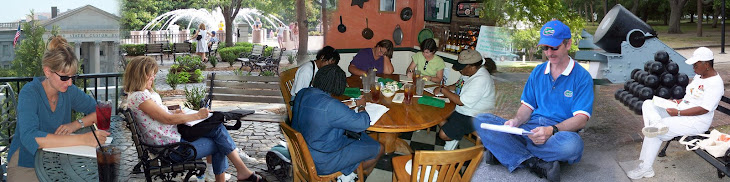
WRITING MARATHON FOR THE TEACHERS AND SUPPORTERS. As a leading up to the event activity, we will sponsor some mini “writing marathons." A regular feature of the Lowcountry Writing Project’s Invitational Summer Institute, these events will give teachers, parents, and other community members an opportunity to experience for themselves the act of using writing to remember, learn about, make sense or, or simply recollect an experience.
Our goal is to have writing groups of 6-10 people each blanket Charleston to write about as many different facets of the area as possible. Using our contacts in the community, we will get free admission to as many site and activities as possible, such as these:
Carriage tours Ghost walks SC Aquarium Historic houses
Churches tour Downtown parks County parks Plantations
Harbor tour Museums Food tour Arts tour
Fort Moultrie Fort Sumter Sports events Theater
Some events, such as a football game or a theater performance, would have set starting times, but others could be designated as “morning” or “afternoon” events, so die-hard writers could sign up for two events. Each group would be led by a professional writer or an LWP Teacher Consultant.
As with the students, each participant could submit a piece of writing based on the activity to our local gallery to showcase Charleston, and to demonstrate how much one can learn about an area by writing about it. We would also create a “local gallery” on the “National Gallery of Writing” web site (http://galleryofwriting.org/) sponsored by the National Council of Teachers of English.
If we generate enough corporate support, we’d like to offer a slot free to every “participating” teacher – that is, every teacher whose students wrote something for the National Day on Writing. For everyone else, we would charge a nominal fee – probably $10 – to cover costs of T-shirts and supplies.
We Need . . .
*experienced writers and teacher consultants to lead the various small groups. We would like to have a sports writer, for example, lead a group to the football game at The Citadel, offering tips on sports writing and on interviewing players and coaches after the game. We would like to have a food critic lead the food tour, and a theater critic lead the theater group, offering tips on how to write a review.
*sponsors for individual events: comp tickets to a theater performance, various museums, carriage tours, a ghost walk, a harbor tour, and so on.
*T-shirts: an appropriate “Celebrate Charleston through Writing” logo, plus logos for sponsors.
*readers to help select “winning” submissions. LWP teachers will carry most of the load, but we’d like to have to professional writers and celebrity readers, too.
*advertising to get the word out: public service announcements, print ads, posters for schools and libraries, and whatever else it takes to let the community know about these events.
Thursday, July 30, 2009

Wednesday, July 29, 2009
Create a Local Gallery as Part of the National Gallery of Writing
Why a National Day on Writing?
In light of the significance of writing in our national life, to draw attention to the remarkable variety of writing we engage in, and to help writers from all walks of life recognize how important writing is to their lives, October 20, 2009, will be celebrated as The National Day on Writing. The National Day on Writing will:
* celebrate the foundational place of writing in Americans' personal, professional, and civic lives.
* point to the importance of writing instruction and practice at every grade level, for every student and in every subject area from preschool through university. (See The Genteel Unteaching of America’s Poor.)
* emphasize the lifelong process of learning to write and composing for different audiences, purposes, and occasions.
* recognize the scope and range of writing done by the American people and others.
* honor the use of the full range of media for composing.
* encourage Americans to write and enjoy and learn from the writing of others.
What is the National Gallery of Writing?
The National Gallery will be a digital archive of compositions accessible to all through a free, searchable website—a living archive of thousands of examples of writing from across the United States.
* Each writer of any age or occupation will be able to submit one composition.
* Writers will include with their composition information about themselves and the reasons they selected and submitted it to the Gallery.
* All sorts of compositions will be accepted, including (but not limited to) electronic presentations, blog posts, documentary clips, poetry readings, “how to” directions, short stories, memos.
* On October 20, 2009, the National Day on Writing, the Gallery will be unveiled for readers.
The National Gallery features three types of display spaces all curated and collected in a variety of galleries:
* The Gallery of the National Council of Teachers of English (NCTE).
* The Galleries of National Partners curated by groups as diverse as Google, the Newseum, Sesame Street’s Electric Company, and the National Science Teachers Association.
* The Galleries of Local Partners curated by groups as diverse as a local Girl Scout troop; a town such as Augusta, Arkansas; a community college course; a bridge club; a city such as Philadelphia, Pennsylvania; a writers group, and local business.
Become a Local Partner
Local partners can be any group, including a family, a few good friends, a club or church group, a class, a school, a workplace group, or an entire city who wants to see their work collected together inside the National Gallery. Every local partner needs one key person: a Curator who applies for local partner status and agrees to review all work submitted before it is published. You can see the existing local galleries here.
The Role of a Curator
The Curator is essentially the filter for the Gallery. While all Gallery Curators will be encouraged to be broad-minded and inclusive, they retain the authority to allow pieces to appear in a gallery or not (note: some writing not chosen from a Local Partner or National Partner Gallery will be referred to NCTE for possible inclusion in the Gallery of the National Council of Teachers of English). Curators will have access to online tools that allow them to "feature" a select number of pieces within their Gallery for a period of time. If a Local Partner Curator anticipates a heavy review load, she or he can recruit assistants who will also have access to review tools. Curators will be responsible for completing a review and triggering a review response email within one month of receipt of each submission.
Some members of the local gallery will need to assume certain roles: curator/writing assistant, October 20th event planner, publicity, fun and camaraderie organizer.
Why Should I Consider Starting a Local Partner Gallery for My Group?
For many good reasons:
* It is a way to help your group think more deeply about how, why, when, and where they write, and share ideas or information that is important to them.
* It can evoke pride, or at least a strong bond, as you see what others post to your Local Gallery.
* It can help you sharpen your own thinking about writing and improve as a writer.
* It can broaden your awareness of the perceptions and talents of others—discoveries that are often hidden in everyday writing.
Getting Started
The first thing a prospective local gallery will want to do is hold an organizational meeting. At the this first meeting, they’ll want to:
* Set a name, theme, and brief description of their Gallery.
* Set a timeline for what they want to accomplish.
* Think about creating a blog or email list or phone tree to communicate among the organizers and members.
Name a curator and maybe assistant curator(s).
* Decide who will apply for the local gallery and when.
* If there is/are an assistant curator(s), the curators will want to to discuss how they’ll handle distribution of submissions/load balancing. The curators will need to develop guidelines for reviewing submissions. See NCTE’s guidelines as a model.
* Check out the information for curators as the gallery develops.
* Use the NCTE NING Group for curators to stay in touch with other sites and gather ideas for their site.
Develop a basic PR outreach strategy
* Use the NCTE model to prepare a press release to announce the gallery once it has been approved.
* Decide on the best places to send the release.
* Make a plan for getting members to write for the gallery.
* Write Letters to local media editors;
* Focus media outreach to TV, Radio
Schedule a follow-up meeting to
* Focus on implementing decisions made at first meeting,
* Provide examples of writing that might be submitted to their gallery.
* Talk about ways of celebrating accomplishments of gallery organizers and participants.
* Make a plan for celebrating their group’s participation in the National Gallery of Writing on the National Day on Writing, October 20, 2009.
Guidelines for Choosing the Writing to be Included
While all writers should be able to express themselves and their point of view, certain kinds of writing simply do not belong in the National Gallery of Writing. Therefore, you may not post or link to writing that:
* is obscene, pornographic, or sexually explicit
* depicts graphic or gratuitous violence
* makes threats of any kind or that intimidates, harasses, or bullies anyone
* is derogatory, demeaning, malicious, defamatory, abusive, or hateful
Prohibition of Unlawful or Harmful Content
Although as the host of the National Gallery, the National Council of Teachers of English (NCTE) is not responsible for the conduct of writers who post here, we want the National Gallery to be a safe and educative site on the Internet. Therefore, in posting to the Gallery, you may not:
* violate any local, state, national, or international law or post any writing that would encourage or provide instructions for a criminal offense
* impersonate any person or entity or otherwise misrepresent yourself, your age, or your affiliation with any person or entity
* make available any unauthorized advertising, promotional materials, "junk mail," "spam," "chain letters," "pyramid schemes," or any other form of solicitation
* All writing submitted to the National Gallery or any Local or Partner Gallery will be reviewed "as is" and will not be modified or amended during the review process.
from http://galleryofwriting.org/guidelines.php
Recruiting Other Groups
If you’d like to recruit local galleries in your area you can contact groups and invite them to organize and you can volunteer to make a presentation to those groups on why and how to set up a local gallery.
* If the groups are already formally organized groups (e.g. a Boy Scout Troop), you can contact the president or group leader to invite them to organize.
* If the groups are not formally organized (e.g., staff and customers of a local business), look for a leader to get things going. That leader would have these attributes: interested in the project, well-organized, energetic, socially committed, might have a role like newsletter editor.
* You may also want to look for helpers in organizing a local group like local librarians or teachers.
* Think about contacting Americorps, sports organizations, Key Clubs, student clubs and NCTE student affiliates, high tech companies, film Schools or media projects, screen writers guild, Best Buy, Target
* Invite these groups to join together on October 20th for a celebration of the writing on the gallery.
Ideas for Celebrating the National Day on Writing
Host a Family Writing Night.
Students could showcase work using poster sessions, computer lab presentations, etc.
To promote the local celebration, the Partner could run a series of personalized ads including:
Hold a Back-to-School Writing Celebration Night.
Hold a Gallery Open House.
Conduct a Spoken Word/Poetry Slam Celebration.
Hold a Writers’ Showcase or “Composition of the Day” leading up to the National Day.
Invite well-known local/regional writers to share their writing processes and samples of their work at school or local group events.
Create a thematic writing event that focuses on a specific cause—this could include showcase chalk art, people writing on post-its or cut outs that could be posted on a wall or public display, graffiti art, letters to the military, writing about trauma or loss, etc.
Hold a write-in.
Suggestions for where to hold Celebrations and Events:
Libraries
Senior Citizen Halls/Residences
Coffee Shops
Restaurants
Boys and Girls Clubs
Scout Meetings
Parent/Teacher Nights
Tech Showcases
Churches
Back to School Nights or Parent Open-Houses
Community Festivals or Events
Book Club Meetings
In light of the significance of writing in our national life, to draw attention to the remarkable variety of writing we engage in, and to help writers from all walks of life recognize how important writing is to their lives, October 20, 2009, will be celebrated as The National Day on Writing. The National Day on Writing will:
* celebrate the foundational place of writing in Americans' personal, professional, and civic lives.
* point to the importance of writing instruction and practice at every grade level, for every student and in every subject area from preschool through university. (See The Genteel Unteaching of America’s Poor.)
* emphasize the lifelong process of learning to write and composing for different audiences, purposes, and occasions.
* recognize the scope and range of writing done by the American people and others.
* honor the use of the full range of media for composing.
* encourage Americans to write and enjoy and learn from the writing of others.
What is the National Gallery of Writing?
The National Gallery will be a digital archive of compositions accessible to all through a free, searchable website—a living archive of thousands of examples of writing from across the United States.
* Each writer of any age or occupation will be able to submit one composition.
* Writers will include with their composition information about themselves and the reasons they selected and submitted it to the Gallery.
* All sorts of compositions will be accepted, including (but not limited to) electronic presentations, blog posts, documentary clips, poetry readings, “how to” directions, short stories, memos.
* On October 20, 2009, the National Day on Writing, the Gallery will be unveiled for readers.
The National Gallery features three types of display spaces all curated and collected in a variety of galleries:
* The Gallery of the National Council of Teachers of English (NCTE).
* The Galleries of National Partners curated by groups as diverse as Google, the Newseum, Sesame Street’s Electric Company, and the National Science Teachers Association.
* The Galleries of Local Partners curated by groups as diverse as a local Girl Scout troop; a town such as Augusta, Arkansas; a community college course; a bridge club; a city such as Philadelphia, Pennsylvania; a writers group, and local business.
Become a Local Partner
Local partners can be any group, including a family, a few good friends, a club or church group, a class, a school, a workplace group, or an entire city who wants to see their work collected together inside the National Gallery. Every local partner needs one key person: a Curator who applies for local partner status and agrees to review all work submitted before it is published. You can see the existing local galleries here.
The Role of a Curator
The Curator is essentially the filter for the Gallery. While all Gallery Curators will be encouraged to be broad-minded and inclusive, they retain the authority to allow pieces to appear in a gallery or not (note: some writing not chosen from a Local Partner or National Partner Gallery will be referred to NCTE for possible inclusion in the Gallery of the National Council of Teachers of English). Curators will have access to online tools that allow them to "feature" a select number of pieces within their Gallery for a period of time. If a Local Partner Curator anticipates a heavy review load, she or he can recruit assistants who will also have access to review tools. Curators will be responsible for completing a review and triggering a review response email within one month of receipt of each submission.
Some members of the local gallery will need to assume certain roles: curator/writing assistant, October 20th event planner, publicity, fun and camaraderie organizer.
Why Should I Consider Starting a Local Partner Gallery for My Group?
For many good reasons:
* It is a way to help your group think more deeply about how, why, when, and where they write, and share ideas or information that is important to them.
* It can evoke pride, or at least a strong bond, as you see what others post to your Local Gallery.
* It can help you sharpen your own thinking about writing and improve as a writer.
* It can broaden your awareness of the perceptions and talents of others—discoveries that are often hidden in everyday writing.
Getting Started
The first thing a prospective local gallery will want to do is hold an organizational meeting. At the this first meeting, they’ll want to:
* Set a name, theme, and brief description of their Gallery.
* Set a timeline for what they want to accomplish.
* Think about creating a blog or email list or phone tree to communicate among the organizers and members.
Name a curator and maybe assistant curator(s).
* Decide who will apply for the local gallery and when.
* If there is/are an assistant curator(s), the curators will want to to discuss how they’ll handle distribution of submissions/load balancing. The curators will need to develop guidelines for reviewing submissions. See NCTE’s guidelines as a model.
* Check out the information for curators as the gallery develops.
* Use the NCTE NING Group for curators to stay in touch with other sites and gather ideas for their site.
Develop a basic PR outreach strategy
* Use the NCTE model to prepare a press release to announce the gallery once it has been approved.
* Decide on the best places to send the release.
* Make a plan for getting members to write for the gallery.
* Write Letters to local media editors;
* Focus media outreach to TV, Radio
Schedule a follow-up meeting to
* Focus on implementing decisions made at first meeting,
* Provide examples of writing that might be submitted to their gallery.
* Talk about ways of celebrating accomplishments of gallery organizers and participants.
* Make a plan for celebrating their group’s participation in the National Gallery of Writing on the National Day on Writing, October 20, 2009.
Guidelines for Choosing the Writing to be Included
While all writers should be able to express themselves and their point of view, certain kinds of writing simply do not belong in the National Gallery of Writing. Therefore, you may not post or link to writing that:
* is obscene, pornographic, or sexually explicit
* depicts graphic or gratuitous violence
* makes threats of any kind or that intimidates, harasses, or bullies anyone
* is derogatory, demeaning, malicious, defamatory, abusive, or hateful
Prohibition of Unlawful or Harmful Content
Although as the host of the National Gallery, the National Council of Teachers of English (NCTE) is not responsible for the conduct of writers who post here, we want the National Gallery to be a safe and educative site on the Internet. Therefore, in posting to the Gallery, you may not:
* violate any local, state, national, or international law or post any writing that would encourage or provide instructions for a criminal offense
* impersonate any person or entity or otherwise misrepresent yourself, your age, or your affiliation with any person or entity
* make available any unauthorized advertising, promotional materials, "junk mail," "spam," "chain letters," "pyramid schemes," or any other form of solicitation
* All writing submitted to the National Gallery or any Local or Partner Gallery will be reviewed "as is" and will not be modified or amended during the review process.
from http://galleryofwriting.org/guidelines.php
Recruiting Other Groups
If you’d like to recruit local galleries in your area you can contact groups and invite them to organize and you can volunteer to make a presentation to those groups on why and how to set up a local gallery.
* If the groups are already formally organized groups (e.g. a Boy Scout Troop), you can contact the president or group leader to invite them to organize.
* If the groups are not formally organized (e.g., staff and customers of a local business), look for a leader to get things going. That leader would have these attributes: interested in the project, well-organized, energetic, socially committed, might have a role like newsletter editor.
* You may also want to look for helpers in organizing a local group like local librarians or teachers.
* Think about contacting Americorps, sports organizations, Key Clubs, student clubs and NCTE student affiliates, high tech companies, film Schools or media projects, screen writers guild, Best Buy, Target
* Invite these groups to join together on October 20th for a celebration of the writing on the gallery.
Ideas for Celebrating the National Day on Writing
Host a Family Writing Night.
Students could showcase work using poster sessions, computer lab presentations, etc.
To promote the local celebration, the Partner could run a series of personalized ads including:
Hold a Back-to-School Writing Celebration Night.
Hold a Gallery Open House.
Conduct a Spoken Word/Poetry Slam Celebration.
Hold a Writers’ Showcase or “Composition of the Day” leading up to the National Day.
Invite well-known local/regional writers to share their writing processes and samples of their work at school or local group events.
Create a thematic writing event that focuses on a specific cause—this could include showcase chalk art, people writing on post-its or cut outs that could be posted on a wall or public display, graffiti art, letters to the military, writing about trauma or loss, etc.
Hold a write-in.
Suggestions for where to hold Celebrations and Events:
Libraries
Senior Citizen Halls/Residences
Coffee Shops
Restaurants
Boys and Girls Clubs
Scout Meetings
Parent/Teacher Nights
Tech Showcases
Churches
Back to School Nights or Parent Open-Houses
Community Festivals or Events
Book Club Meetings
Thursday, July 23, 2009
Chicken Soup for the Soul Quick Story Call Out
VERY QUICK STORY CALL OUT FOR NEW TITLE!
TWO WEEK DEADLINE!!
Chicken Soup for the Soul: Count Your Blessings
101 Stories of Gratitude, Fortitude, and Silver Linings
This follow-on book to Chicken Soup for the Soul: Tough Times, Tough People continues Chicken Soup for the Soul's focus on inspiration and hope in these difficult times. These inspirational stories remind us that each day holds something to be thankful for -- whether it is having the sun shine or having food on the table. Power outages and storms, health scares and illnesses, job woes and financial insecurities, housing challenges and family worries test us all. But there is always a silver lining. The simple pleasures of family, home, health, and inexpensive good times are described.
We are looking for true stories and poems written in the first person of no more than 1,200 words. Stories can be serious or humorous, or both. They should not have been previously published by Chicken Soup for the Soul or other major publications.
Here are a few suggested topics:
How you count your blessings or express your gratitude
What made you realize that your life is good and that you are grateful
Silver linings that you have discovered in the midst of challenging events
What is really valuable in your life
Major life changes or events for which you are grateful
How you spread the message of gratitude to your family and friends
The joy of simple pleasures
The unexpected benefits of health challenges or other life changes
This book is in the process of being completed and will go to the printer in September for publication in October! It is a featured Chicken Soup for the Soul title for Christmas 2009. The deadline for submissions is soon, so if you can submit quickly you have a better chance than normal of being chosen.
If your story is chosen, you will be a published author and your bio will be printed in the book if you so choose. You will also receive a check for $200 and 10 free copies of your book, worth more than $100. You will retain the copyright for your story.
SUBMISSIONS GO TO http://chickensoupforthesoul.com/form.asp?cid=submit_story.
DEADLINE IS MONDAY AUGUST 3rd. THANK YOU!
TWO WEEK DEADLINE!!
Chicken Soup for the Soul: Count Your Blessings
101 Stories of Gratitude, Fortitude, and Silver Linings
This follow-on book to Chicken Soup for the Soul: Tough Times, Tough People continues Chicken Soup for the Soul's focus on inspiration and hope in these difficult times. These inspirational stories remind us that each day holds something to be thankful for -- whether it is having the sun shine or having food on the table. Power outages and storms, health scares and illnesses, job woes and financial insecurities, housing challenges and family worries test us all. But there is always a silver lining. The simple pleasures of family, home, health, and inexpensive good times are described.
We are looking for true stories and poems written in the first person of no more than 1,200 words. Stories can be serious or humorous, or both. They should not have been previously published by Chicken Soup for the Soul or other major publications.
Here are a few suggested topics:
How you count your blessings or express your gratitude
What made you realize that your life is good and that you are grateful
Silver linings that you have discovered in the midst of challenging events
What is really valuable in your life
Major life changes or events for which you are grateful
How you spread the message of gratitude to your family and friends
The joy of simple pleasures
The unexpected benefits of health challenges or other life changes
This book is in the process of being completed and will go to the printer in September for publication in October! It is a featured Chicken Soup for the Soul title for Christmas 2009. The deadline for submissions is soon, so if you can submit quickly you have a better chance than normal of being chosen.
If your story is chosen, you will be a published author and your bio will be printed in the book if you so choose. You will also receive a check for $200 and 10 free copies of your book, worth more than $100. You will retain the copyright for your story.
SUBMISSIONS GO TO http://chickensoupforthesoul.com/form.asp?cid=submit_story.
DEADLINE IS MONDAY AUGUST 3rd. THANK YOU!
Saturday, June 27, 2009

Friday, June 26, 2009
Places to Publish Short Memoir
* Thin Threads
* Chicken Soup for the Soul
* Cup of Comfort for the Soul
* Skirt!
* Brevity
To find places to publish memoir:
* Funds for Writers
* Writers Market
* Chicken Soup for the Soul
* Cup of Comfort for the Soul
* Skirt!
* Brevity
To find places to publish memoir:
* Funds for Writers
* Writers Market
Some Cool Writing Prompts
[Being Unprepared] Because you have been sick, out of town, busy at work, or working on other homework, you didn't have as much time to study for an important test as you needed. Everyone going to school has been in this situation. Think of a specific test that you took that you felt unprepared for and narrate the events. Tell your readers about the preparation that you were able to do, the reasons that you didn't get to prepare as well as you wanted, taking the test, and any significant events that happened after you took the test. Your paper should help readers understand what it felt like to be unprepared.
[Lightbulb Moment] Think of an experience when you realized that you suddenly understood an idea, a skill, or a concept you had been struggling with -- it might be something related to a class that you took or a specific athletic skill you were trying to perfect. For instance, you might think about trying to understand how to identify iambic pentameter in a poem or how to complete a Taylor Series problem in your Calculus class. Or you might consider trying to perfect your free throws and suddenly understanding how your follow-through was affecting your success. Write a narrative that tells the story of your movement toward understanding. How did you finally come to understand? What changed your perceptions and gave you a new understanding? Your paper should help readers understand how you felt to struggle with the idea or skill and then to understand.
[Childhood Event] Choose a vivid time from your childhood — You might think of the first time that you rode a school bus, of a time when you went to the principal's office, the first A you earned on a test or paper, earning money to buy something that you really wanted, and so on. Narrate the events related to the childhood memory that you've chosen so that your readers will understand why the event was important and memorable.
[Achieving a Goal] Think of a time when you achieved a personal goal — you might have finally completed a marathon or triathlon, or you might have bettered your score on the SATs or another test, or you might have learned how to use a piece of software like Microsoft Word or Excel. Tell your readers about the story of how you met your goal. Be sure that your readers understand why the goal is important to you.
[The Good and the Bad] Think about an event in your life that seemed bad but turned out to be good. Maybe you got injured and while you were waiting for your broken leg to heal, you learned how to use a computer. What makes the event change from bad to good may be something that you learned as a result, something that you did differently as a result, or something that happened that wouldn't have occurred otherwise. Tell the story of the event that you experienced and help your readers understand how an event that seemed negative turned out to have valuable consequences.
[Being a Teacher] Teaching someone else how to do something can be rewarding. Think of a skill that you've taught someone else how to do. Perhaps you taught someone else how to swim, showed someone how to bake a souffle, or helped someone learn how to study more effectively. Think about the events that made up the process of teaching the skill, and narrate the story for your readers.
[Changing Places] Every place has things that change — sometimes as the result of economics, sometimes because different people are involved, and sometimes for no clear reason that you know about. Think of a change to a place that you know well. Perhaps the local grocery store you grew up with as Smith and Bros. Grocery was bought out by a regional chain like Food Lion or Winn Dixie. Maybe the First National Bank of Smithburg suddenly becomes NationsBank. Perhaps the change was more personal -- an older sibling moves out of the house and your family changes the room to a guest room or an office. Think of a specific change and narrate the events that occurred. Readers should know the details of the change, and they should know how you feel about the changes that occurred.
[Personal Rituals] Describe a personal ritual that you, your friends, or your family have. Think about the personal steps that you always go through when you prepare for an exam. Do you sit at a desk, spread books and notes across your bed, or use the kitchen table? Do you have to have something to drink...soda, water, jolt? There are numerous things that we do for which we create our own personal rituals. Choose one event — studying for a test, writing a paper, dressing and warming up before a game, or preparing and having a special family meal. Narrate the events that take place when you complete your ritual so that your readers understand the steps that the ritual includes and why you complete them.
[Standing Up] Choose a time when you did something that took a lot of nerve, a time when you didn't follow the crowd or a time when you stood up for your beliefs. Perhaps your friends were urging you to do something that you were uncomfortable with and you chose not to cave into peer pressure. Maybe you took a stance on a political issue that was important in your community, or you might have Whatever you choose, think about the details of the event and write a story that tells about what happened. Your narrative should show your readers why you decided to make a stand or try something that took nerve, give specifics on the events, and share how you felt after the event.
[Disagreeing] Think of a time when you disagreed with a decision that had been made and did something about it. The decision might have been made by someone you know personally — your Biology teacher announced a new policy to grade for spelling and grammar on your quizzes and homework, or an older family member decides to cancel a subscription to a magazine that you liked to read. You might have responded by discussing your concerns with your principal or dean, or you might have decided to get a part-time job to earn enough money to buy the magazine yourself. Or the decision could have been made by someone you never met — perhaps your school board decided to change the lines in your school district so that you would have to go to a different school, or your state legislature has passed a bill that you disagreed with. Your response might have been to write a letter to the editor, to your state representative, or to the school board. Whatever happened, your job is to write a paper that narrates the events that occurred -- from the decision that was made to your response. Be sure that your paper gives enough details that your readers understand why you disagreed with the decision and why you felt that your response was appropriate.
From: http://tengrrl.com/tens/019.shtml
[Lightbulb Moment] Think of an experience when you realized that you suddenly understood an idea, a skill, or a concept you had been struggling with -- it might be something related to a class that you took or a specific athletic skill you were trying to perfect. For instance, you might think about trying to understand how to identify iambic pentameter in a poem or how to complete a Taylor Series problem in your Calculus class. Or you might consider trying to perfect your free throws and suddenly understanding how your follow-through was affecting your success. Write a narrative that tells the story of your movement toward understanding. How did you finally come to understand? What changed your perceptions and gave you a new understanding? Your paper should help readers understand how you felt to struggle with the idea or skill and then to understand.
[Childhood Event] Choose a vivid time from your childhood — You might think of the first time that you rode a school bus, of a time when you went to the principal's office, the first A you earned on a test or paper, earning money to buy something that you really wanted, and so on. Narrate the events related to the childhood memory that you've chosen so that your readers will understand why the event was important and memorable.
[Achieving a Goal] Think of a time when you achieved a personal goal — you might have finally completed a marathon or triathlon, or you might have bettered your score on the SATs or another test, or you might have learned how to use a piece of software like Microsoft Word or Excel. Tell your readers about the story of how you met your goal. Be sure that your readers understand why the goal is important to you.
[The Good and the Bad] Think about an event in your life that seemed bad but turned out to be good. Maybe you got injured and while you were waiting for your broken leg to heal, you learned how to use a computer. What makes the event change from bad to good may be something that you learned as a result, something that you did differently as a result, or something that happened that wouldn't have occurred otherwise. Tell the story of the event that you experienced and help your readers understand how an event that seemed negative turned out to have valuable consequences.
[Being a Teacher] Teaching someone else how to do something can be rewarding. Think of a skill that you've taught someone else how to do. Perhaps you taught someone else how to swim, showed someone how to bake a souffle, or helped someone learn how to study more effectively. Think about the events that made up the process of teaching the skill, and narrate the story for your readers.
[Changing Places] Every place has things that change — sometimes as the result of economics, sometimes because different people are involved, and sometimes for no clear reason that you know about. Think of a change to a place that you know well. Perhaps the local grocery store you grew up with as Smith and Bros. Grocery was bought out by a regional chain like Food Lion or Winn Dixie. Maybe the First National Bank of Smithburg suddenly becomes NationsBank. Perhaps the change was more personal -- an older sibling moves out of the house and your family changes the room to a guest room or an office. Think of a specific change and narrate the events that occurred. Readers should know the details of the change, and they should know how you feel about the changes that occurred.
[Personal Rituals] Describe a personal ritual that you, your friends, or your family have. Think about the personal steps that you always go through when you prepare for an exam. Do you sit at a desk, spread books and notes across your bed, or use the kitchen table? Do you have to have something to drink...soda, water, jolt? There are numerous things that we do for which we create our own personal rituals. Choose one event — studying for a test, writing a paper, dressing and warming up before a game, or preparing and having a special family meal. Narrate the events that take place when you complete your ritual so that your readers understand the steps that the ritual includes and why you complete them.
[Standing Up] Choose a time when you did something that took a lot of nerve, a time when you didn't follow the crowd or a time when you stood up for your beliefs. Perhaps your friends were urging you to do something that you were uncomfortable with and you chose not to cave into peer pressure. Maybe you took a stance on a political issue that was important in your community, or you might have Whatever you choose, think about the details of the event and write a story that tells about what happened. Your narrative should show your readers why you decided to make a stand or try something that took nerve, give specifics on the events, and share how you felt after the event.
[Disagreeing] Think of a time when you disagreed with a decision that had been made and did something about it. The decision might have been made by someone you know personally — your Biology teacher announced a new policy to grade for spelling and grammar on your quizzes and homework, or an older family member decides to cancel a subscription to a magazine that you liked to read. You might have responded by discussing your concerns with your principal or dean, or you might have decided to get a part-time job to earn enough money to buy the magazine yourself. Or the decision could have been made by someone you never met — perhaps your school board decided to change the lines in your school district so that you would have to go to a different school, or your state legislature has passed a bill that you disagreed with. Your response might have been to write a letter to the editor, to your state representative, or to the school board. Whatever happened, your job is to write a paper that narrates the events that occurred -- from the decision that was made to your response. Be sure that your paper gives enough details that your readers understand why you disagreed with the decision and why you felt that your response was appropriate.
From: http://tengrrl.com/tens/019.shtml
Thursday, June 25, 2009
Memoir Daily Log
Submitted by Lilless McPherson Shilling
Journal. Delores led us in our journal writing. She asked us to write a six-word memoir based on some of the following topics: your first job, your first kiss, what you were like in elementary school, secret of being in a good relationship or marriage, your biggest regret, the best trip you ever took.
Delores gave us a handout of personal history questions from Real Simple magazine and suggested a website for six-word memoirs: www.smithmag.net/sixwords.
Snacks. I introduced the snacks, including some that were “memoir” snacks: orange slices, ginger snaps, fig bars, popcorn, and fruit cocktail.
Odds & ends. We talked about plans for the October writing marathon.
Book discussion. We discussed Bret Lott’s memoir, Before We Get Started. The conversation centered on Lott’s reliance on faith and the similarities and differences between Lott and Stephen King.
Similarities: Both authors discuss rejection, the influence of their wives, and the importance of discipline and honesty in writing. Both admire the writing of Raymond Carver, a short story writer.
Differences: King uses humor and profane language to humorous effect. While both referred to other writers, Lott uses much longer quotes.
Mini-lesson. Amy led us in a mini-lesson on dialog. She asked us to think about when to use it, when not to use it, how to use it, and how to make it sound realistic. She said, “In memoir, it’s a way of bringing other peoples’ voices into your text.” Our exercise was to create a dialogue between Stephen King, Bret Lott, and William Zinsser. She handed out “12 Exercises for Improving Dialog.”
We devoted the rest of our session to response group and writing time.
Journal. Delores led us in our journal writing. She asked us to write a six-word memoir based on some of the following topics: your first job, your first kiss, what you were like in elementary school, secret of being in a good relationship or marriage, your biggest regret, the best trip you ever took.
Delores gave us a handout of personal history questions from Real Simple magazine and suggested a website for six-word memoirs: www.smithmag.net/sixwords.
Snacks. I introduced the snacks, including some that were “memoir” snacks: orange slices, ginger snaps, fig bars, popcorn, and fruit cocktail.
Odds & ends. We talked about plans for the October writing marathon.
Book discussion. We discussed Bret Lott’s memoir, Before We Get Started. The conversation centered on Lott’s reliance on faith and the similarities and differences between Lott and Stephen King.
Similarities: Both authors discuss rejection, the influence of their wives, and the importance of discipline and honesty in writing. Both admire the writing of Raymond Carver, a short story writer.
Differences: King uses humor and profane language to humorous effect. While both referred to other writers, Lott uses much longer quotes.
Mini-lesson. Amy led us in a mini-lesson on dialog. She asked us to think about when to use it, when not to use it, how to use it, and how to make it sound realistic. She said, “In memoir, it’s a way of bringing other peoples’ voices into your text.” Our exercise was to create a dialogue between Stephen King, Bret Lott, and William Zinsser. She handed out “12 Exercises for Improving Dialog.”
We devoted the rest of our session to response group and writing time.
Wednesday, June 24, 2009
June 24, 2009 Daily Log
8:30am- class started with another gorgeous sunrise over The Citadel Beach House on IOP.
Journal exercise by Lynda Biel used art to release the literary muse. We used crayons to color & draw images inside a mandala circle. Our guided imagery was to answer the questions: How do our 'masks' help us with our writing? When do our 'masks' hinder our writing?
A visitor to the beach club provided Amy with a potential opportunity to do some future interviewing of a WWII veteran. This could lead to an oral history project for the Lowcountry Writing Project.
Amy led us in a mini-lessons on seeing objects in a new way. This produced a writing assignment that we shared with each other.
We had a time to share our current writing project. Many meaningful remarks were exchanged.
Delicious snacks were enjoyed throughout class.
We talked about future assignments: the Brett Lott review and meta-text, in letter form.
Have a creative evening,
Lynda
Journal exercise by Lynda Biel used art to release the literary muse. We used crayons to color & draw images inside a mandala circle. Our guided imagery was to answer the questions: How do our 'masks' help us with our writing? When do our 'masks' hinder our writing?
A visitor to the beach club provided Amy with a potential opportunity to do some future interviewing of a WWII veteran. This could lead to an oral history project for the Lowcountry Writing Project.
Amy led us in a mini-lessons on seeing objects in a new way. This produced a writing assignment that we shared with each other.
We had a time to share our current writing project. Many meaningful remarks were exchanged.
Delicious snacks were enjoyed throughout class.
We talked about future assignments: the Brett Lott review and meta-text, in letter form.
Have a creative evening,
Lynda
Volunteer at a Creativity Summer Camp at Edisto

CREATE!
Hey you!
What are your summer plans?
Want an excuse to go to Edisto Island and have a blast, all while making a difference in the lives of some of the coolest
kids you’ll ever meet?
SideWalk Chalk presents CREATE, a summer art and writing camp for the students of Jane Edwards Elementary in Edisto.
We are looking for volunteers to assist us in this adventure!
If you are an artist, writer, gardener, actor, or athlete, AWESOME! We’ll put your skills to use. If you are not any of those, AWESOME! We’ll still put you to use!
CREATE is to take place over the month of July and will include workshops in short story writing, painting, poetry, photography, gardening, and much more! We will also be putting on a play and creating a mural for the school.
Come help out for a day, a week, or the whole month.
Here are the dates and times that are available to volunteers:
WEEK ONE WEEK THREE
Monday July 6 Monday July 20
Tuesday July 7 Tuesday July 21
Wednesday July 8 Wednesday July 22
WEEK TWO WEEK FOUR
Monday July 13 Monday July 27
Tuesday July 14 Tuesday July 28
Wednesday July 15 Wednesday July 29
Thursday July 30
Friday July 31
ALL DATES ARE 8:30AM – 2:00PM EXCEPT FOR THURSDAY THE 30th WHICH IS 8:30AM TO 7:00PM.
AN INFORMATIONAL MEETING WILL BE HELD ON MONDAY, JUNE 29TH ON THE 3RD FLOOR OF SOUTHEND BREWERY AND SMOKEHOUSE LOCATED AT 161 E. BAY ST. AT 6PM. PLEASE CALL JANA AT
(843) 822- 2038 IF YOU HAVE ANY QUESTIONS. GET MORE INFORMATION AT WWW.SIDEWALKCHALK.US
Tuesday, June 23, 2009
Daily Log Tuesday, June 23, 2009
Prepared by Delores Schweitzer
We started today’s class with a journal prompt by Grier. She explained how she uses and grades journals in her classes, emphasizing the importance of give students some choice and flexibility in how they approach the assignment, while still holding them to high expectations in length, specificity, and commitment to following directions. Grier brought a stack of folders that held postcards or pictures clipped from magazines and books. Typically, the students choose a folder (sometimes, she lets them choose a second time if they don’t like what they pick), and then they get instructions on what to write. Examples are:
• Write a letter trigger by the picture. Who is the letter to? Who from? What is it about?
• Write a story about what you see. Make sure there is a beginning, middle and end.
• Describe what you see in sentences (or brainstorm clusters, for younger students).
• Draw your own version of the picture and change some element. Then tell about that change.
• Use the picture as a bridge to a personal experience or other art (music, book, movie) or idea you have encountered in the news, science, the Bible, etc.
Grier invited us to choose whatever approach we wanted. Our pictures ranged from photos to portraits to landscapes, providing for lots of interesting stories.
Snacks were provided by Delores, featuring Latte Poundcake with coffee glaze (all decaf, so as not to give us the shakes), fruit tossed in lavender syrup, Fig Newtons and packages of trail mix. The recipe for the lavender syrup is as follows:
Boil one cup of water. Remove from heat. Steep two tablespoons of lavender flowers in the water for at least ten minutes. Strain flowers from water, or better still, use a tea ball to contain them while steeping. Reheat water to boiling, remove from heat, and add one cup of sugar, stirring until it is dissolved. Allow syrup to cool and store in the refrigerator. Use as a dressing for fruit salads – together, they make a great fruit compote to go on top of pancakes, pound cake or vanilla ice cream!
Next, we discussed our readings from In Brief: Short Takes on the Personal and On Writing Well by William Zinsser. We started with the stories from In Brief that we liked, considering the techniques that worked for us and why. Some of the favorites were “Swimming with Canoes,” “A Sense of Water,” “Bobcats,” and “The Indian Dog,” while none of us seemed particularly crazy about “The Missing Star.” We spoke at length about the virtues of creating short pieces that convey feelings and events in a variety of different ways, and how these stories might be used in a class situation. Upon reviewing our experience of the Zinsser book, we found it closer to a style manual than the Lott or King books. Having signed up for a memoir class, it is not surprising that we prefer Lott’s and King’s approaches to teaching the craft of writing with carefully chosen examples from their own lives. However, we agree that Zinsser has many valuable things to say about writing, and it is a text well-suited to college classes.
In today’s Mini Lesson, Amy asked us to visualize one particular object and write it down. After checking that we had all done this, she asked us to explain how our mothers were like the objects we chose. We did so, and then shared what we wrote. Amy explained that there was power in unexpected comparisons, as shown in some of the originality of pairings, and our challenge as writers is to avoid the schmaltzy and cliché, looking for original ways to present ideas and paint visual pictures for our readers. She also emphasized the importance of looking at the hard stuff – the unattractive parts of the people we are describing – because this lends credibility to our objectivity as storytellers.
After the Mini Lesson, Teri and Lynda went to the computer lab, as their King discussion was completed yesterday. Grier, Lilless and Delores met to plan the discussion of Bret Lott’s book on Thursday. After this, we spent the last hour of class writing and/or revising our memoirs.
Amy closed class with reminders of what to bring and how to prepare for the Beach House activities tomorrow.
We started today’s class with a journal prompt by Grier. She explained how she uses and grades journals in her classes, emphasizing the importance of give students some choice and flexibility in how they approach the assignment, while still holding them to high expectations in length, specificity, and commitment to following directions. Grier brought a stack of folders that held postcards or pictures clipped from magazines and books. Typically, the students choose a folder (sometimes, she lets them choose a second time if they don’t like what they pick), and then they get instructions on what to write. Examples are:
• Write a letter trigger by the picture. Who is the letter to? Who from? What is it about?
• Write a story about what you see. Make sure there is a beginning, middle and end.
• Describe what you see in sentences (or brainstorm clusters, for younger students).
• Draw your own version of the picture and change some element. Then tell about that change.
• Use the picture as a bridge to a personal experience or other art (music, book, movie) or idea you have encountered in the news, science, the Bible, etc.
Grier invited us to choose whatever approach we wanted. Our pictures ranged from photos to portraits to landscapes, providing for lots of interesting stories.
Snacks were provided by Delores, featuring Latte Poundcake with coffee glaze (all decaf, so as not to give us the shakes), fruit tossed in lavender syrup, Fig Newtons and packages of trail mix. The recipe for the lavender syrup is as follows:
Boil one cup of water. Remove from heat. Steep two tablespoons of lavender flowers in the water for at least ten minutes. Strain flowers from water, or better still, use a tea ball to contain them while steeping. Reheat water to boiling, remove from heat, and add one cup of sugar, stirring until it is dissolved. Allow syrup to cool and store in the refrigerator. Use as a dressing for fruit salads – together, they make a great fruit compote to go on top of pancakes, pound cake or vanilla ice cream!
Next, we discussed our readings from In Brief: Short Takes on the Personal and On Writing Well by William Zinsser. We started with the stories from In Brief that we liked, considering the techniques that worked for us and why. Some of the favorites were “Swimming with Canoes,” “A Sense of Water,” “Bobcats,” and “The Indian Dog,” while none of us seemed particularly crazy about “The Missing Star.” We spoke at length about the virtues of creating short pieces that convey feelings and events in a variety of different ways, and how these stories might be used in a class situation. Upon reviewing our experience of the Zinsser book, we found it closer to a style manual than the Lott or King books. Having signed up for a memoir class, it is not surprising that we prefer Lott’s and King’s approaches to teaching the craft of writing with carefully chosen examples from their own lives. However, we agree that Zinsser has many valuable things to say about writing, and it is a text well-suited to college classes.
In today’s Mini Lesson, Amy asked us to visualize one particular object and write it down. After checking that we had all done this, she asked us to explain how our mothers were like the objects we chose. We did so, and then shared what we wrote. Amy explained that there was power in unexpected comparisons, as shown in some of the originality of pairings, and our challenge as writers is to avoid the schmaltzy and cliché, looking for original ways to present ideas and paint visual pictures for our readers. She also emphasized the importance of looking at the hard stuff – the unattractive parts of the people we are describing – because this lends credibility to our objectivity as storytellers.
After the Mini Lesson, Teri and Lynda went to the computer lab, as their King discussion was completed yesterday. Grier, Lilless and Delores met to plan the discussion of Bret Lott’s book on Thursday. After this, we spent the last hour of class writing and/or revising our memoirs.
Amy closed class with reminders of what to bring and how to prepare for the Beach House activities tomorrow.
Subscribe to:
Posts (Atom)


.jpg)


